My Personal AI Operations Layer Runs in Telegram
I have been experimenting with a small personal AI operations layer: a Hermes agent running continuously on a Mac mini at home and communicating through a private Telegram group.
The choice of Telegram was deliberate. It is already my daily messaging app, and Telegram’s BotFather makes the integration straightforward. More importantly, I did not want another productivity dashboard, browser tab, or app that I would need to remember to open. I wanted an assistant that could place the right prompt or summary in the place I already check throughout the day.
The system currently runs four scheduled jobs in Singapore time:
- 6:00 AM: a market and investment briefing, focused on the companies and tickers I follow.
- 6:30 AM: a compact AI news digest.
- 7:00 AM: a direct message asking for my single highest-priority task for the day.
- 11:55 PM: a consolidation pass that turns my task logs into an Obsidian daily note.
Each job is small on its own. Together, they create a useful rhythm: orient, focus, stay informed, and leave behind a record.
Why Hermes?
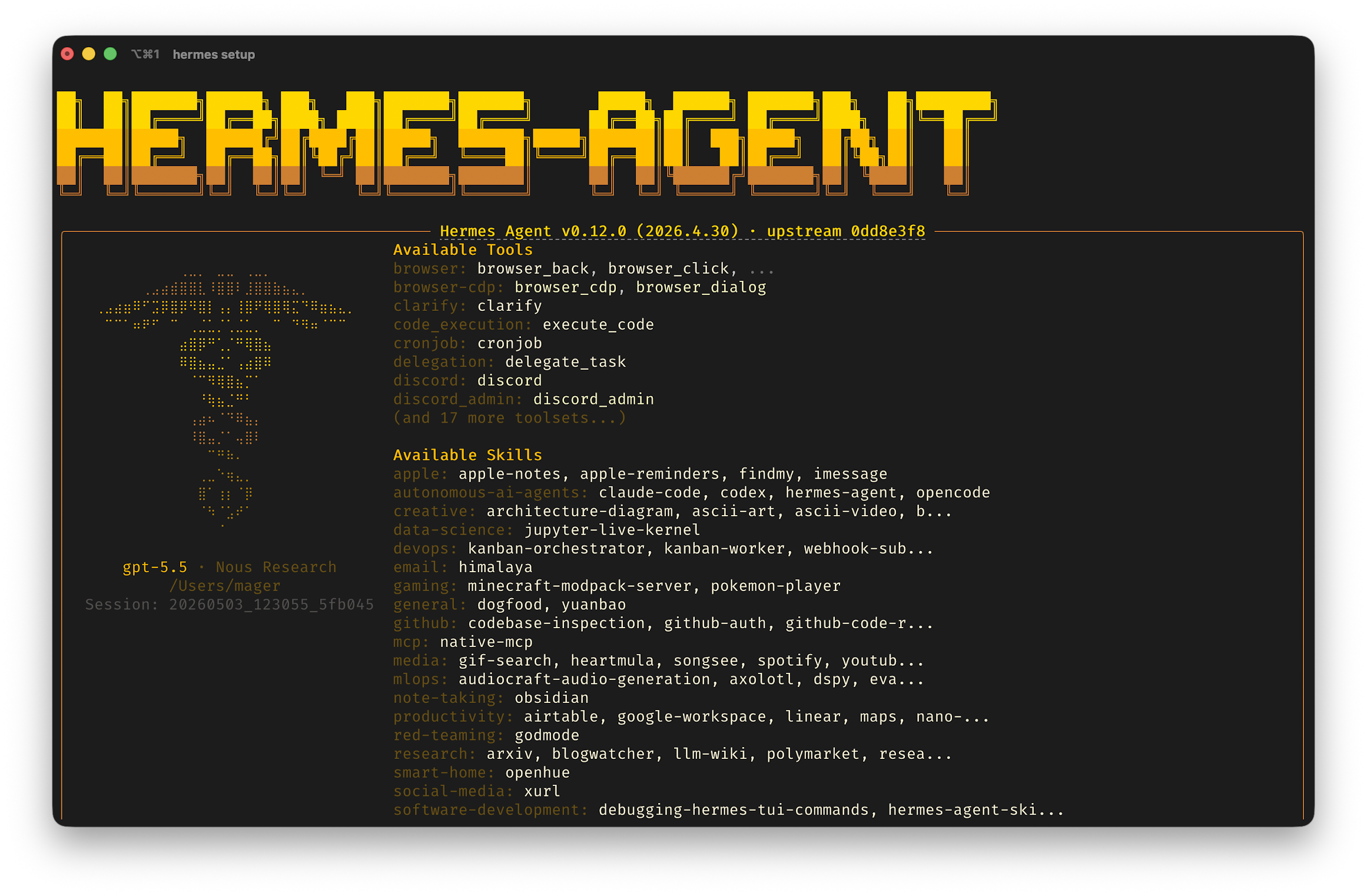
I considered the broader category of self-hosted personal assistants, especially Hermes and OpenClaw. Both can run locally, connect to Telegram, use external models, and automate recurring work. The choice came down to what I wanted the system to optimize for.
Hermes felt more aligned with an automation-first workflow. Its built-in cron scheduler can deliver scheduled work to messaging platforms, it supports model switching without reworking the agent, and it emphasizes persistent memory and reusable skills. That makes it a good home for routines such as daily research briefs, task-log consolidation, and a growing personal knowledge base. Hermes Agent
OpenClaw is compelling in a different direction. It has wider messaging coverage, more developed companion-app and voice capabilities, a visual Canvas, and explicit multi-agent routing across isolated workspaces. If this evolves from a Telegram-based personal system into an assistant that needs to work across devices, channels, and richer media, I would revisit it. OpenClaw
For now, Hermes wins because it keeps the system close to the actual use case: lightweight, scheduled, text-first personal operations.
The workflow
The morning investment briefing follows the public sources and tickers I care about. Its job is not to make investment decisions. It is to reduce the overhead of finding what changed overnight: earnings-related updates, macro headlines, material company news, and themes that could affect the watchlist.
The AI digest does the same for a field that moves too quickly to track through scattered tabs. Rather than trying to read everything, I want a short list of developments worth opening later: model releases, research, product launches, infrastructure shifts, and notable industry moves.
The priority check-in may be the simplest automation, but it is possibly the most valuable. At 7:00 AM, the agent asks one question: what is the most important thing to move forward today? The constraint matters. It converts a vague, reactive task list into an explicit daily commitment.
At night, the agent becomes an archivist. I write rough task logs throughout the day without worrying too much about structure. At 11:55 PM, Hermes consolidates those fragments into an Obsidian daily note. Over time, that creates a searchable record of decisions, work completed, open loops, and recurring patterns: a personal knowledge base built from the work itself rather than from a separate documentation ritual.
Cost and model choice
The system runs on DeepSeek V4 Flash. These jobs are frequent, repetitive, and largely text-based, so cost efficiency matters more than using the strongest available model for every invocation.
A lightweight model is sufficient for summarisation, formatting, synthesis, and recurring prompts. The trade-off is modality: the current setup is text-only. If I later want image analysis or visual generation, I will add model routing so those requests are sent to a model that supports them, while routine jobs remain on the cheaper path.
That division feels more sensible than treating every task as if it needs premium inference.
Privacy is part of the design
Giving an autonomous agent access to personal systems is less a prompting problem than a permissions problem.
The agent has its own email identity rather than access to my primary inbox. That boundary is intentional: a personal AI assistant should not automatically inherit every sensitive account, conversation, document, or credential simply because it is convenient.
The next safeguards are equally important: separate OS access, narrowly scoped credentials, explicit tool allowlists, and keeping high-impact actions behind confirmation. Self-hosting on a Mac mini gives me control over where the agent runs, but local hosting alone does not make an agent safe. The real protection comes from limiting what it can read, write, send, and delete.
What I am building toward
I do not think the interesting outcome is “an AI bot in a group chat.” The interesting outcome is a personal operating layer that quietly compounds.
It should know which information I follow, preserve a record of what I worked on, surface the right question at the right time, and become more useful without asking me to adopt another elaborate system.
The best version of this does not feel like using AI. It feels like having less administrative drag between noticing something, deciding what matters, and doing the work.